
There is a question that every software company selling AI has had to answer since 2023: what, exactly, is the thing you are charging for?
It sounds like a detail for the finance team. It isn’t. The unit a company bills in determines who absorbs cost increases, who keeps the benefit of cost declines, whether revenue grows without a salesperson, and whether a customer can budget for the product at all. Get it wrong and a technically excellent product loses money on its best customers.
Three years in, the industry has produced four broad answers, several public reversals, and no consensus. What follows is an attempt to lay out how the market arrived here, what each approach actually costs the people using it, and what an investor might reasonably watch to tell which way it resolves.
How software got priced, three times
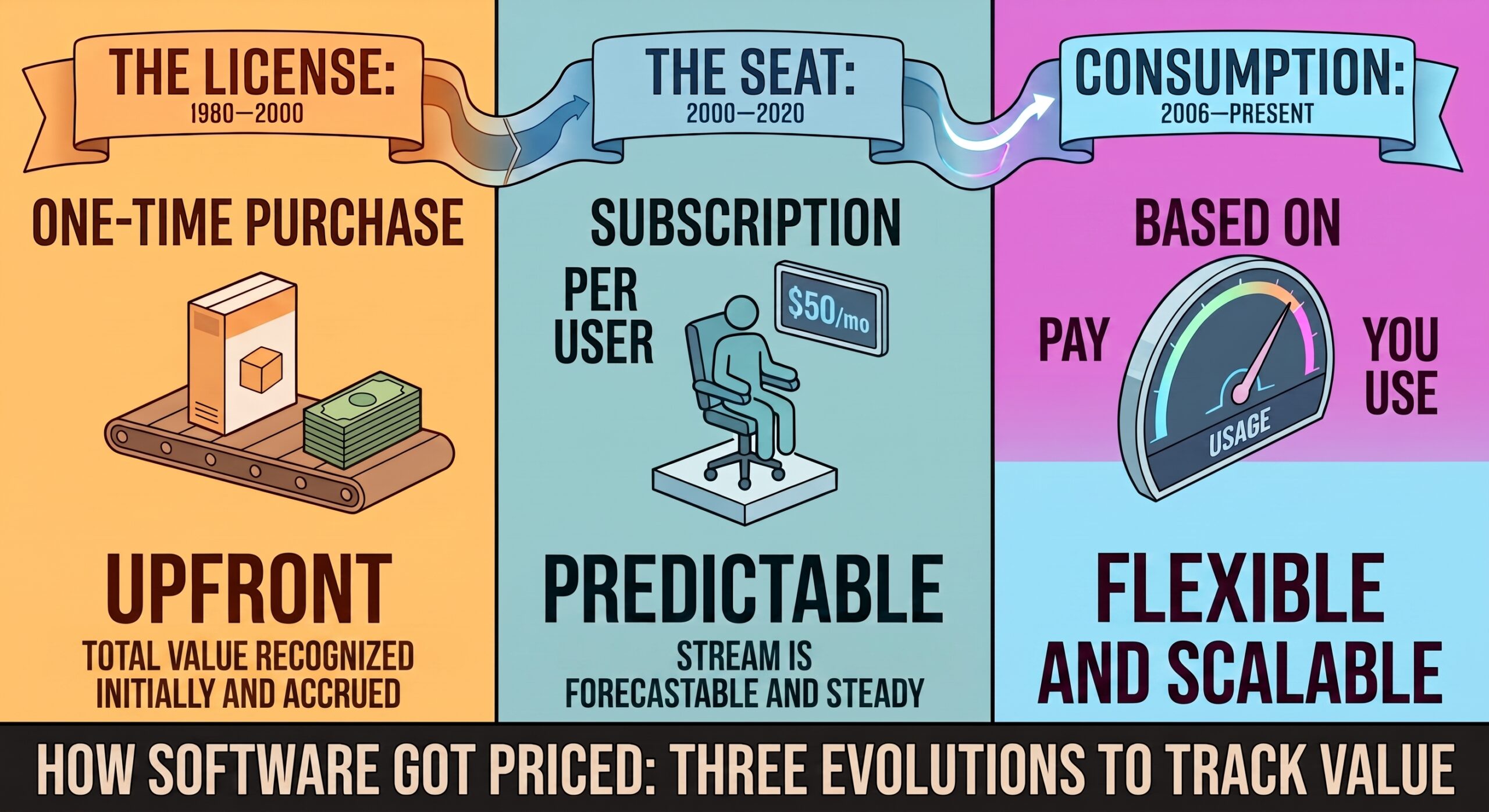
Software pricing has been rebuilt twice already. Both times, the trigger was the same: the unit being billed stopped tracking the value being delivered.
The licence (roughly 1980–2000). Software was a product in a box. You paid once, owned a version, and paid again when you wanted the next one. Revenue was lumpy, tied to release cycles, and the vendor’s incentive ended at the point of sale.
The seat (roughly 2000–2020). Salesforce’s arrival in 1999 popularised the model that defined a generation: a recurring fee per user per month. Its elegance was that a seat is a proxy for a person doing work, and the number of people doing work is a decent approximation of how much value a company gets from a tool. It was predictable for the buyer, forecastable for the seller, and it built the entire modern technology industry.
Consumption (roughly 2006–present). AWS began charging for compute by the hour. Snowflake later built a business on charging for storage, compute and queries as they were used. Twilio charged per API call. Consumption worked where the seat didn’t: infrastructure has no natural relationship to headcount, and it introduced the idea that revenue could expand inside an existing account without anyone selling anything.
By the mid-2020s most of the industry was some blend of the second and third. Then the seat started to fail in a way it hadn’t before.
Why the seat broke
The seat was always a proxy. It assumed a person sat behind the licence, doing the work, and that more work meant more people.
AI severs that link in both directions.
Going one way, the software now does the work itself overnight, in parallel, with no person attached. A vendor charging per seat captures nothing from an agent that handles a thousand tasks while the office is closed. Going the other way, the customer who extracts the most value may need fewer people to do it, which under seat pricing means they pay the vendor less for getting more.
Snowflake’s CEO Sridhar Ramaswamy put the vendor-side version of this bluntly in May 2026: companies “reliant on seat-based income will scramble to justify their premiums as employees use AI to accomplish an immense amount of work.”
Public markets reached the same conclusion, faster and less gently. A Jefferies trader coined “SaaSpocalypse” in February 2026; by 31 March the SEG SaaS Index, 120-plus listed software companies, was down 25.7% year to date. The declines concentrated in horizontal, seat-priced platforms where the argument that an agent could do the same job without a licence was easiest to make. Private software M&A multiples had already compressed from 6.7x revenue in 2021–22 to 3.1x by the second half of 2025.
Whether that repricing was correct is a separate argument. What is not in dispute is that the market has stopped treating the seat as a safe unit.
The cost line that never used to exist
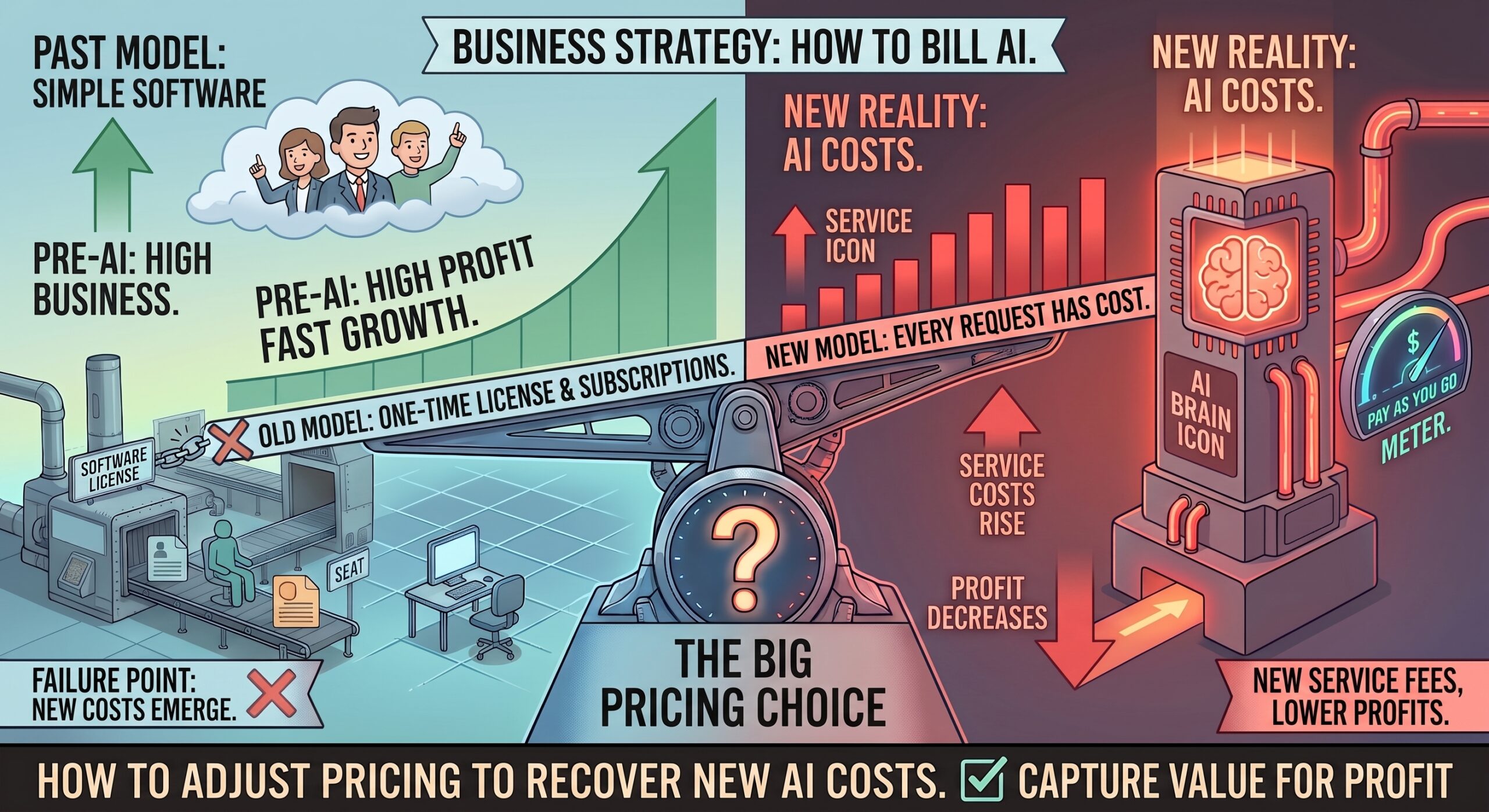
There is a second force at work, and it sits on the cost side.
Traditional software has a near-zero marginal cost of service. Once built, the ten-thousandth user is served for almost nothing. That single characteristic is the reason software companies earn the gross margins they do, and the reason investors have been willing to pay for growth ahead of profit.
AI does not work that way. Every request has to be computed, and computing it costs real money that lands in the cost of goods sold. Andreessen Horowitz documented the consequence as early as 2020, and it has broadly held since: AI-centric businesses tend to run gross margins in the 50–60% band where comparable software businesses run 60–80% or higher.
So the industry is being rebuilt on both sides simultaneously: a revenue model that no longer fits, against a cost line that didn’t previously exist. That combination is why pricing has become the strategic question rather than an administrative one.
Four experiments running in public
Four approaches are now visible in the market. None is dominant.
Metered credits. The vendor defines an internal currency and charges for consumption of it. Salesforce sells Agentforce Flex Credits at US$500 per 100,000, with a single agent action drawing 20 credits, about ten cents. Microsoft meters agent work in Copilot Credits at roughly a cent each, on top of the seat. GitHub moved Copilot from a fixed “premium request” allowance to consumption-metered AI Credits on 1 June 2026, with credits drawn against published per-model token rates.
Outcome pricing. The vendor charges only when something is achieved. Zendesk was first in customer service, announcing outcome-based pricing for automated resolutions in August 2024: customers pay only for issues an AI agent resolves without a human. Intercom’s Fin charges US$0.99 per resolved conversation. Sierra, founded by Bret Taylor, built its business on the principle; Taylor’s argument is that “when you charge for something closer to a business value, it’s actually more valuable,” and that escalating to a human should be free.
Hybrid. A seat for access, metering for work. Microsoft 365 Copilot is the reference case: roughly US$360 per user per year at list, with agentic consumption billed separately. This is now the most common structure in the market: 61% of companies were using some hybrid model as of 2025, and 85% of SaaS leaders had adopted usage-based pricing in some form.
Absorb and bundle. Give the AI away inside the existing product and defend the subscription. Gartner expects this to be a significant force, forecasting that GenAI will drive a US$58 billion shakeup in productivity software through 2027, partly as vendors move previously paid features into no-cost tiers.
What each model breaks
No approach is clean. Each transfers a different problem to a different party.
Metered credits transfer budget risk to the customer. Nobody has an intuition for what a credit is worth, so nobody can forecast the bill. GitHub’s transition is the cautionary case: heavy users reported agentic bills rising by factors of ten to fifty, and the developer response to the change was summarised in one widely-quoted line: “you will get less, but pay the same price.” A bill that lands at several times the forecast damages the relationship regardless of product quality.
Outcome pricing transfers delivery risk to the vendor. It is the most intellectually satisfying model and the hardest to operate. If the work is harder than assumed, the vendor absorbs it. And “outcome” must be defined tightly enough to survive a dispute: Intercom’s published definition of a billable resolution runs to a substantial list of exclusions covering escalations, failed procedures, clarifying questions and human handoff requests. Every one of those exclusions is a negotiation someone had to have.
Seats understate value and overstate cost. The light user and the heavy user pay the same while costing wildly different amounts to serve.
Bundling defers the problem rather than solving it. Giving AI away protects the subscription, but the compute bill still arrives, and it now sits inside gross margin where investors can see it.
The deflation puzzle
Underneath all of this is a fact that is widely known and almost universally misread.
The cost of AI is collapsing. Andreessen Horowitz calls it LLMflation and puts the decline at roughly 10x per year: faster, they note, than compute costs fell during the PC era or bandwidth during the dotcom build-out. Epoch AI, measuring the price of reaching a given performance level, finds declines between 9x and 900x annually depending on the task. Output that cost around US$60 per million tokens in 2023 is available for under a dollar today.
The intuitive conclusion is that AI is getting cheaper to sell. The invoices say otherwise. Menlo Ventures put enterprise spending on generative AI at US$37 billion in 2025, up 3.2x from US$11.5 billion the year before, during precisely the period when unit prices were collapsing.
The mechanism is straightforward once stated. Cheaper units invite more consumption, and the newer generation of agentic systems consume far more per task. Anthropic’s own engineering write-up of its multi-agent research system gives the clearest published figures: agents use roughly four times the tokens of a chat interaction, and multi-agent systems roughly fifteen times. This is Jevons’ paradox, the nineteenth-century observation that more efficient use of coal increased total coal consumption rather than reducing it.
There is a further wrinkle that complicates the naive price-war thesis. Menlo’s survey found enterprise buyers in high-value domains such as coding to be relatively price-insensitive, choosing capability over cost. Where the work matters, buyers are not shopping on unit price at all, which is an argument against assuming that cheaper inference must translate into cheaper products.
Per unit, AI is getting dramatically cheaper. Per invoice, it is getting more expensive. Any durable pricing model has to survive both facts at once.
The question nobody has settled
Which brings the argument to its actual unresolved point.
If a vendor bills in a unit that is linked to its own costs, tokens, or credits priced at cost-plus, then every future price decline passes through to the customer. The vendor has built a business whose principal input gets cheaper each year and captured none of the benefit.
If a vendor bills in a unit linked to value delivered, a resolution, a verified document, a completed outcome, it keeps the benefit of deflation, but takes on the volatility of delivery.
Every pricing decision being made in enterprise AI right now is, underneath, a bet on that trade. The industry has not converged, and the honest position is that it is too early to say which side is right. What can be said is that most vendors have not made the choice deliberately: they inherited a unit from the model provider’s price list and passed it along.
Four questions worth asking
These apply to any AI company, not a particular one.
- Is the billing unit linked to cost or to value? That single answer determines who benefits as models get cheaper.
- What share of what was sold actually gets used? Unused credits are deferred revenue and a churn signal, not growth.
- Does gross margin improve as volume rises? If not, the company is reselling compute.
- Is AI cost of goods disclosed at all? Many companies still bury it. The ones that don’t are usually the ones that can afford not to.
Disclosure: where Straker sits
Straker has a position in this debate, so read the following as an interested party rather than a neutral observer.
Customers on arbitr pay a recurring platform fee and then draw on two balances: Intelligence Credits for machine work, and Trust Credits for human verification. The design intent is a value-linked unit rather than a cost-linked one, a credit buys a quantity of finished, verified work rather than a quantity of compute, which places Straker on the second side of the trade described above. It is a deliberate choice rather than an inherited one.